

A Written Trading Plan for Manual Trading
Which sections a trading plan for manual trading should have, how to write rules you can actually follow and an example of a one-page plan for MT5.
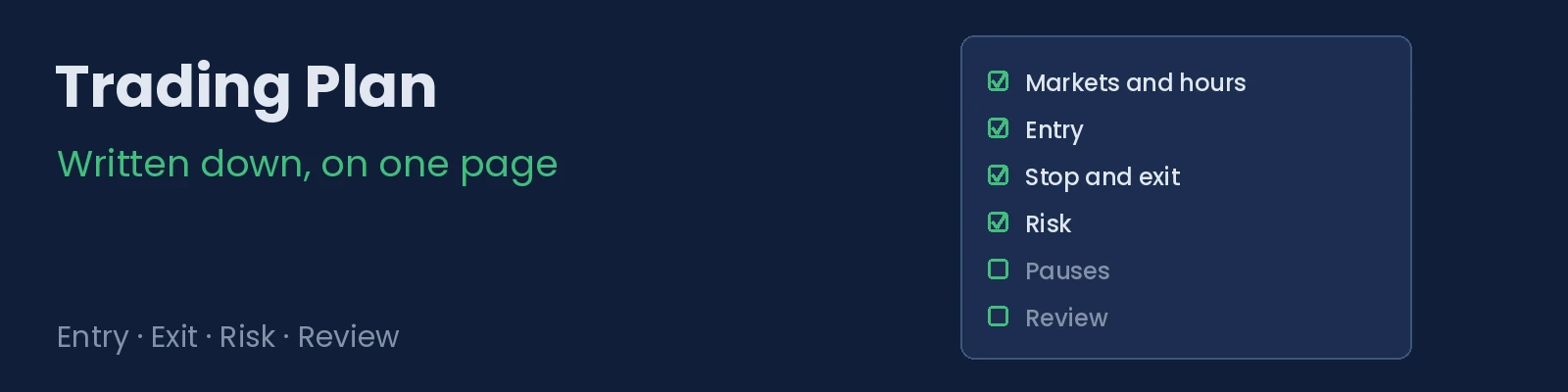
Almost every trader has a plan. Few have it in writing. And a plan that only exists in your head changes without you noticing: after a losing streak, after a big win or simply on a day when you are in a hurry. Writing it down does not guarantee results, but it turns every decision into something you can review. This article explains what a plan for manual trading should include, how to write rules you can follow and how to keep it alive.
1. Why write it down
A written plan does three things:
- It decides before there is money at stake. Rules are thought through calmly, not with a trade open.
- It tells you whether you failed or the method failed. If you followed the plan and lost, the problem is the method. If you did not follow it, the problem is execution. Without a written plan, the two get mixed up.
- It makes improvement possible. You can only change something in an orderly way if it is written down.
2. The sections of a plan
Markets and hours
Which assets you trade, on which timeframe and in which time window. A few assets and a schedule that fits your life are better than many assets half-watched. If your trading hours depend on the session, keep them in server time, as I explain in Market Sessions and Server Time in MT5.
Entry conditions
What has to happen for you to enter, written so that someone else could check it on the chart. “I buy when I see strength” is not a rule. “I buy at a zone marked before the session, with the H4 trend up and after an H1 close above the previous candle’s high” is.
Stop and exit
Where the initial stop goes, whether and when you move it, and where you take profit. Management after entry is part of the plan, not something decided on the spot. I cover the options in Managing the Stop After Entry.
Risk
Three numbers:
- Risk per trade, as a percentage of the account.
- Open risk limit, adding up all positions.
- Monthly loss limit, after which you stop trading until the next month.
I explain the last two in Total Open Risk and a Monthly Loss Limit. To calculate the lot for each trade from the risk and the stop you can use Zone Risk Planner or its free version, Zone Risk Planner Core, which do not open or close trades.
Pause rules
What you do when things go wrong or when you are not in a fit state to trade: for example, no trading after three losses in a row on the same day, no trading when tired or rushed, and no new trades in the minutes before a major release if your method is not designed for it.
Review
How often you review the plan and with which data. Changing rules after every loss is not reviewing, it is improvising.
3. How to write rules you can follow
- Use conditions that can be checked. Prices, closes, levels and times, not feelings.
- Write down what you do not do as well. “I do not trade the first half hour of Wall Street” is as useful as an entry rule.
- Keep it to one page. If the plan is too long to read before each session, you will not read it.
- Date each version. That way you know which rules applied in each period of your journal.
4. Example of a one-page plan
| Section | Example |
|---|---|
| Markets | DE40 and EURUSD |
| Timeframe | Trend on H4, entry on H1 |
| Hours | 9:00 to 12:00 CET |
| Entry | Pullback to a zone marked before the session, in the direction of the H4 trend, with a confirming H1 close |
| Initial stop | On the other side of the zone, at least 1 H1 ATR away |
| Exit | Target at the next relevant high or low; if there is not at least 1.5R, there is no trade |
| Management | No breakeven; trailing stop below the last H1 low from +1.5R |
| Risk | 0.5% per trade, 2% open risk, 5% monthly limit |
| Pause | Three losses in a row in the day, or the monthly limit reached |
| Review | The first weekend of each month, with the trading journal |
Illustrative example. The figures depend on each trader and method; they are not a recommendation.
5. Keeping it alive
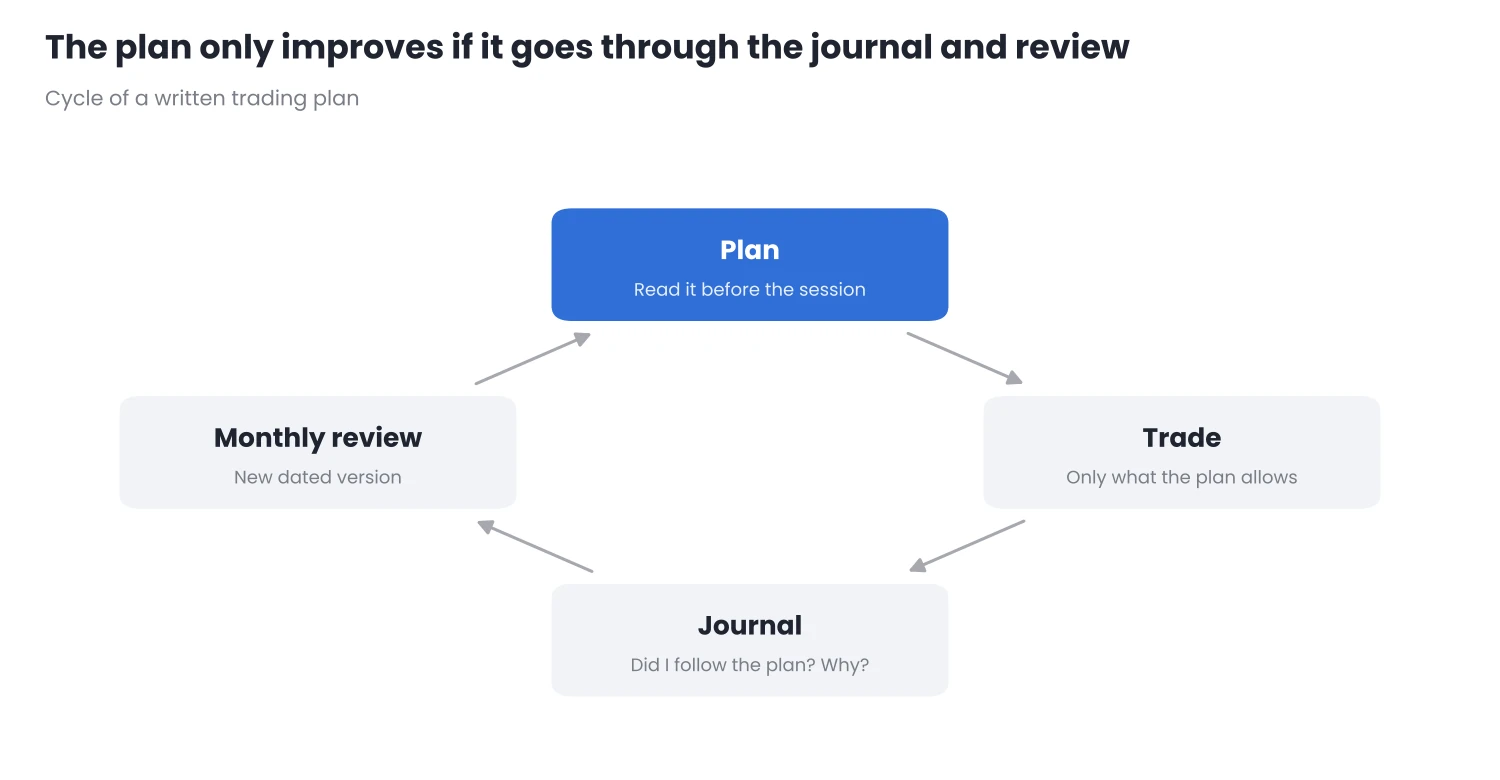
Figure 1. The plan only improves if it goes through the journal and a regular review.
The plan, the journal and the review form a cycle:
- Before the session, read the plan and mark the zones on the chart.
- During the session, trade only what the plan allows.
- After each trade, record in your journal whether you followed the plan or not, and why.
- Once a month, review the journal and decide whether to change any rule. If you change it, create a new dated version of the plan.
Conclusion
- A written plan separates method errors from execution errors. Without it, you do not know which of the two is costing you money.
- It should cover markets, hours, entry, exit, risk, pauses and review, with rules that can be checked on the chart.
- One page is enough. What matters is reading it before trading and reviewing it with data, not after every loss.
Write the first version of your plan today, even if it is incomplete, and use it for a month on a demo account before adjusting it.
Want to bring this to your chart?
Jasopex tools for MetaTrader help you plan your risk before you trade.
See the tools