

During a Losing Streak: Rules to Stick to Your Plan
The most common mistakes during a losing streak, how to set pause rules before one arrives and a short review to tell a normal streak from an execution problem.
Every strategy with an edge goes through losing streaks. What does most damage to an account is usually not the streak itself, but what the trader does during it: raising risk to recover, changing method or opening trades the plan does not allow. This article focuses on that, on behaviour. I explain what streak length is normal for each win rate in Drawdown and Recovery, on the MQL5 blog.
1. The mistakes that turn a streak into a problem
Raising risk to recover
This is the most expensive mistake. The idea seems logical: with a slightly larger trade, a single win recovers the losses. The problem is that the streak can continue, and each loss now weighs more.
| Risk during 5 consecutive losses | Account loss |
|---|---|
| Fixed 1% on every trade | 4.9% |
| Risk 50% higher after each loss (1%, 1.5%, 2.25%…) | 12.6% |
| Risk doubled after each loss (1%, 2%, 4%…) | 28.0% |
Illustrative example. It does not include costs or slippage.
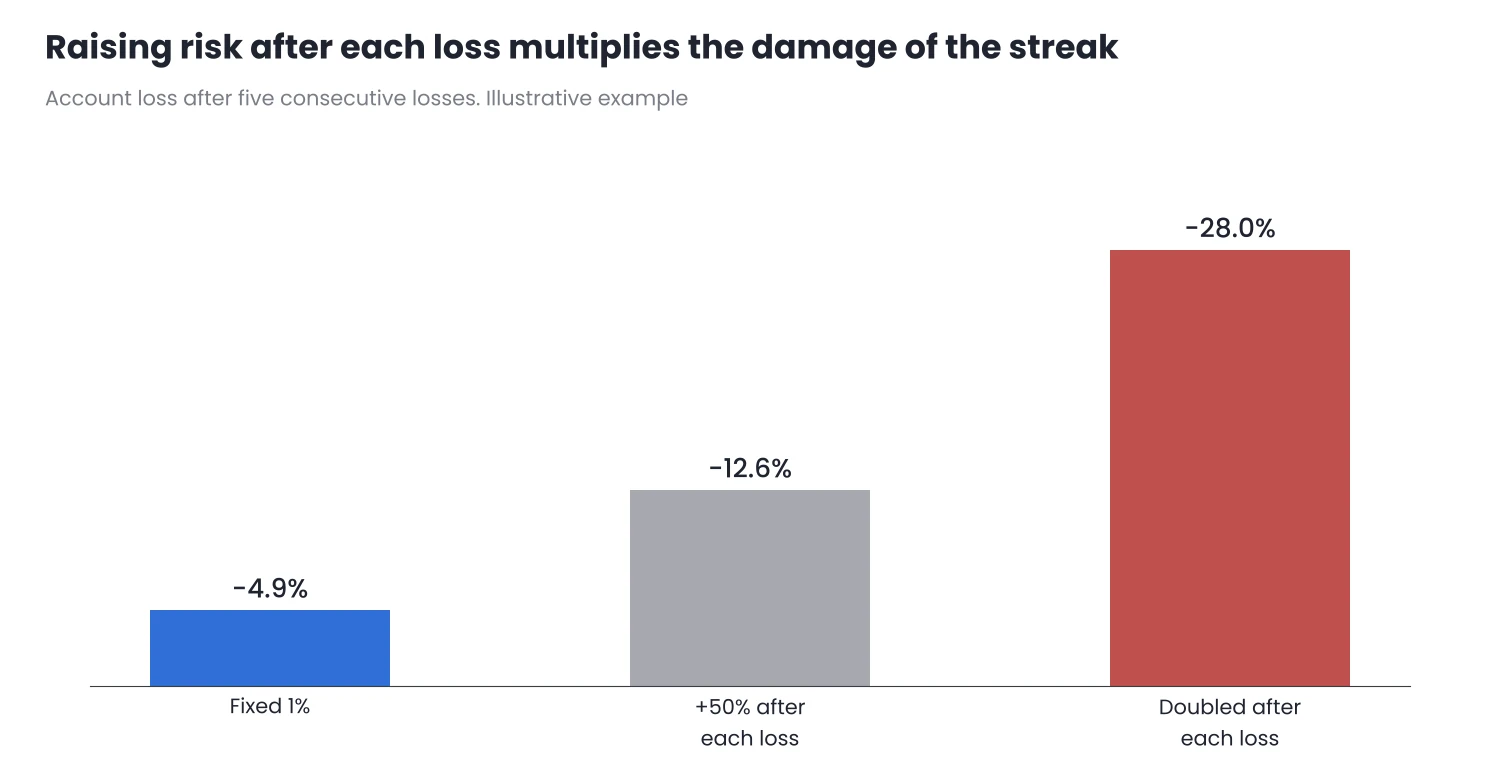
Figure 1. The same streak of five losses costs 4.9% with fixed risk and 28% when risk is doubled.
The same streak that is a setback with fixed risk can cost more than a quarter of the account if risk rises after each loss.
Changing method
After several losses, another strategy looks better. But changing method in the middle of a streak usually means abandoning it at its worst moment, without enough data to know whether it has stopped working.
Trading outside the plan
Trades that do not meet every condition, entries outside your hours or on assets not in the plan become more frequent after several losses. Each one adds risk without the edge that justifies the method.
Skipping the good trades
The opposite mistake exists too: after several losses, the trader hesitates and lets the next valid trade go. If that one turns out to be a winner, the streak gets longer in the journal without the method having failed.
2. Pause rules, decided in advance
Decisions made during a streak are shaped by it. That is why pause rules are written into the plan before it arrives:
- Daily limit. For example, ending the session after three losses in a row or after losing a fixed percentage in the day.
- Monthly limit. Stopping new trades until the next month once a loss limit is reached, also counting open risk. I explain this in Total Open Risk and a Monthly Loss Limit.
- Stepped risk reduction. If the account falls by a set percentage from its peak, reduce the risk per trade, for example by half, until part of the drop is recovered. It is the opposite of raising risk to recover.
- No rule changes mid-period. Rules are only changed at the scheduled review, not during the streak.
These rules belong in your written trading plan, with specific figures.
3. A short review: normal streak or problem?
When a pause rule is triggered, the goal is not to find someone to blame, but to answer one question: are the losses coming from the method or from how I am applying it?
| What you find | What it probably means | What to do |
|---|---|---|
| Every trade met the plan | A normal streak for the method | Continue with the same rules when the pause ends |
| Several trades did not meet the plan | An execution problem | Review which rule failed and why before returning |
| The market has changed behaviour (for example, from trend to range) | The method is out of its context | Trade less or wait for its context to return |
| Costs or slippage higher than usual | An execution or broker problem | Review hours, spreads and order types |
| The streak far exceeds anything in the history | A possible change in the method | Analyse with more data before continuing with real money |
Indicative. A single streak is rarely enough to conclude that a method has stopped working.
This review needs a journal: without a record of each trade and whether it met the plan, all that is left is the feeling that “nothing works”.
4. How to return to trading
- When the pause ends, not before. If the rule says the day is over, it is over.
- With the review done. Even if it only takes ten minutes, with the journal in front of you.
- With the risk the plan sets. If the plan reduces risk after a drop, you return with the reduced risk; you do not make up for it with larger trades.
- If in doubt, on demo. A few trades on a demo account help you check that you are executing the plan as written again.
Conclusion
- The damage of a streak depends mostly on what you do during it. Raising risk, changing method or trading outside the plan make it worse.
- Pause rules are decided in advance: a daily limit, a monthly limit and stepped risk reduction, with specific figures in the plan.
- The review answers one question: whether the losses come from the method or from execution. That requires a journal.
Write your pause rules today and add them to your plan before your next session. When a streak arrives, you will not have to decide anything in the heat of the moment.
Want to bring this to your chart?
Jasopex tools for MetaTrader help you plan your risk before you trade.
See the tools